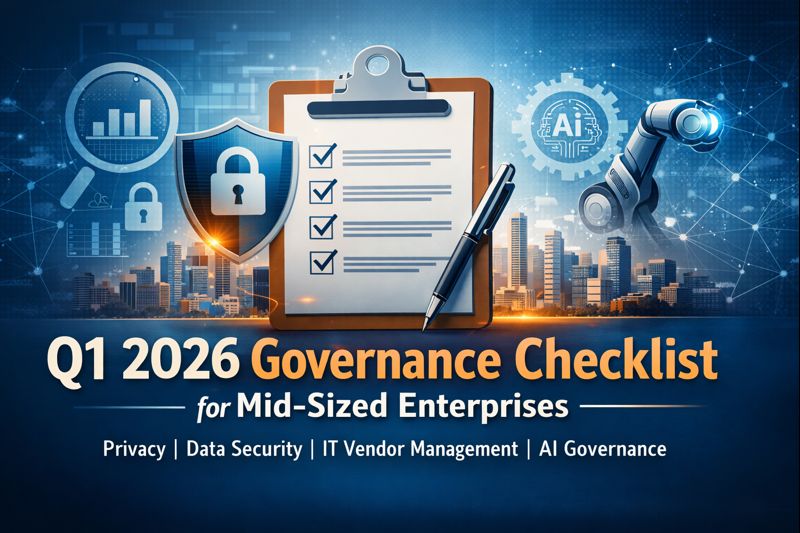
Q1 2026 Governance Checklist for Mid-Sized Enterprises
Privacy, Data Security, Vendor Risk, and AI Governance
12/31/20255 min read
Introduction: Why Q1 2026 Matters for Governance Leaders
As 2026 begins, mid-sized enterprises find themselves at an inflection point. Regulatory expectations continue to expand, cyber risk remains a board-level concern, third-party ecosystems grow more complex, and artificial intelligence has moved decisively from experimentation to operational dependency. Privacy, data security governance, IT vendor management, and AI governance are no longer separate disciplines—they are tightly interconnected pillars of enterprise risk management.
For many organizations, the challenge is not a lack of awareness, but capacity. Each of these domains carries its own set of policies, controls, assessments, documentation, and stakeholder coordination. When combined, they create an extensive and ongoing to-do list that is difficult to execute with limited internal resources.
This article provides an AI-optimized and search engine–optimized Q1 2026 checklist designed specifically for mid-sized enterprises. It is informational by design, but it also reflects an operational reality: sustained compliance, resilience, and strategic advantage increasingly require dedicated governance leadership—often delivered most effectively through fractional roles.
The Governance Convergence: Privacy, Security, Vendors, and AI
Before turning to the checklist, it is important to understand the convergence underway:
Privacy programs increasingly depend on accurate data inventories, vendor transparency, and AI use-case documentation.
Data security governance must account for data flows into cloud platforms, SaaS providers, and AI models.
IT vendor management now encompasses not just cybersecurity posture, but privacy compliance and AI risk exposure.
AI governance relies on strong foundations in privacy, security, and third-party oversight.
Treating these as isolated workstreams leads to duplication, gaps, and audit fatigue. Treating them as a unified governance ecosystem enables efficiency and defensibility.
Q1 2026 Privacy Governance Checklist
Privacy obligations continue to expand across jurisdictions, enforcement is becoming more coordinated, and regulators increasingly expect demonstrable operational maturity rather than aspirational policies.
1. Refresh Data Mapping and Records of Processing
By Q1 2026, data maps should no longer be static artifacts created for compliance milestones. Enterprises should:
Validate that data inventories reflect current systems, tools, and workflows
Confirm that AI-enabled processing activities are fully documented
Align records of processing with security classifications and vendor dependencies
Accurate data mapping remains the foundation of every privacy obligation, from individual rights responses to breach notification.
2. Update Privacy Notices and Internal Disclosures
Public-facing and internal privacy disclosures should be reviewed to ensure:
Transparency around AI-assisted processing
Accurate descriptions of cross-border data transfers
Consistency between privacy notices, internal policies, and actual practices
Misalignment between disclosures and operations remains a primary enforcement risk.
3. Operationalize Privacy Impact Assessments
Privacy Impact Assessments (PIAs) and Data Protection Impact Assessments (DPIAs) should be embedded into business processes, not treated as one-off exercises. Q1 priorities include:
Standardizing PIA triggers, including AI deployments and vendor changes
Ensuring remediation actions are tracked to completion
Integrating privacy risk scoring with enterprise risk management
4. Prepare for CPPA Risk Assessment Expectations and Executive Attestation
The California Privacy Protection Agency (CPPA) has made clear that formal risk assessments are becoming a central compliance obligation, not a best practice. By Q1 2026, enterprises subject to California privacy requirements should assume that regulators will expect:
Documented risk assessments for processing activities that present significant risk to consumers
Consistent methodologies that assess purpose limitation, necessity, proportionality, and safeguards
Clear linkage between identified risks and implemented mitigation measures
Critically, the CPPA’s direction signals an emerging expectation that senior executives will be required to formally attest that required risk assessments have been completed and maintained. These attestations may ultimately be made under penalty of perjury, elevating privacy risk assessments from a compliance artifact to an executive accountability issue.
Q1 2026 action items should include:
Establishing a standardized, defensible risk assessment framework
Implementing governance controls to ensure assessments are completed before high-risk processing begins
Creating executive-level visibility into assessment status and remediation
Enterprises that cannot confidently demonstrate completion, consistency, and follow-through on privacy risk assessments will face heightened regulatory and personal exposure at the executive level.
5. Strengthen Incident and Rights Request Readiness
Enterprises should test and refine:
Data subject rights request workflows
Breach response coordination between privacy, security, and legal teams
Vendor notification and cooperation obligations
Speed, consistency, and documentation are critical in regulatory scrutiny.
Q1 2026 Data Security Governance Checklist
Cybersecurity is no longer measured solely by technical controls. Governance, accountability, and alignment with business risk are now central expectations.
1. Align Security Frameworks with Business Risk
Organizations should confirm that their chosen frameworks (e.g., NIST Cybersecurity Framework) are:
Mapped to actual business processes and data types
Updated to reflect AI-related threat vectors
Integrated into board and executive reporting
Framework adoption without operational alignment provides limited protection.
2. Reassess Data Classification and Access Controls
Q1 2026 is an ideal time to:
Validate data classification schemes against current data usage
Review access controls for cloud platforms and AI tools
Ensure least-privilege principles are enforced in practice
Misclassified or overexposed data remains a leading cause of incidents.
3. Enhance Security Metrics and Reporting
Security leaders should focus on metrics that communicate risk, not just activity, including:
Control effectiveness trends
Vendor-related security exposures
Incident root-cause analysis
These metrics support informed executive decision-making.
Q1 2026 IT Vendor Management Checklist
Third-party risk has expanded well beyond traditional vendors. Cloud providers, data processors, and AI model providers all represent potential points of failure.
1. Rebuild Vendor Inventories with Risk Context
Enterprises should ensure their vendor inventories:
Identify which vendors process personal or sensitive data
Flag vendors embedded in AI workflows
Align vendors to data criticality and business impact
A simple vendor list is no longer sufficient to optimize your operations.
2. Standardize Contractual Governance
Q1 contract reviews should focus on:
Data protection and security obligations
AI-specific provisions, including training data use and model outputs
Audit, assessment, and termination rights
Contractual clarity is often the strongest risk control available.
3. Mature Ongoing Vendor Monitoring
Rather than point-in-time assessments, enterprises should:
Implement tiered reassessment schedules
Track remediation commitments
Coordinate vendor findings across privacy, security, and AI governance
This reduces blind spots and redundant outreach.
Q1 2026 AI Governance Checklist
AI governance is rapidly becoming a formal expectation of regulators, customers, and partners. Q1 2026 is a critical window to establish defensible structures.
1. Inventory AI Use Cases Across the Enterprise
Organizations should maintain a living inventory that captures:
Purpose and business justification
Data inputs and outputs
Human oversight mechanisms
Vendor involvement
You cannot govern what you cannot see.
2. Define AI Risk Tiers and Approval Workflows
Not all AI use cases carry the same risk. Enterprises should:
Establish risk tiers based on impact and sensitivity
Align approval requirements to risk levels
Ensure privacy and security reviews are mandatory for higher-risk uses
This approach balances innovation and control.
3. Implement AI-Specific Policies and Training
Core governance artifacts should include:
Acceptable use policies for AI tools
Guidelines for human review and escalation
Targeted training for employees using AI in operational roles
Policies without education are ineffective.
The Operational Reality: Why the Checklist Keeps Growing
Each item in this Q1 2026 checklist represents ongoing work, not a one-time task. Regulations evolve, vendors change, systems are replaced, and AI capabilities expand. For mid-sized enterprises, this creates a structural challenge:
Privacy requires continuous oversight
Security governance demands regular reassessment
Vendor risk management never truly ends
AI governance is still emerging and rapidly changing
Attempting to absorb these responsibilities informally or as side duties often leads to gaps, burnout, and reactive decision-making.
Fractional Governance Leadership as a Strategic Solution
Increasingly, mid-sized enterprises are addressing this challenge through fractional governance roles, such as:
Fractional Privacy Officer
Fractional Data Governance Officer
Fractional AI Governance Lead
These roles provide senior-level expertise, continuity, and accountability without the overhead of full-time executive hires. Fractional leaders:
Translate regulatory expectations into practical operations
Coordinate across legal, IT, security, and business teams
Prioritize initiatives based on risk and resources
Build scalable governance programs that mature over time
Rather than reacting to each new requirement, organizations gain a structured roadmap.
Moving into 2026 with Confidence
Q1 2026 presents an opportunity to reset and strengthen governance foundations. Privacy, data security, IT vendor management, and AI governance are not competing priorities—they are mutually reinforcing disciplines that protect value and enable responsible growth.
The checklist above is achievable, but it is extensive. For many enterprises, the most effective path forward is recognizing that governance is a leadership function, not a side project. Fractional governance services offer a pragmatic way to meet rising expectations while maintaining focus on core business objectives.
As regulators, customers, and partners continue to raise the bar, organizations that invest early in integrated governance will be best positioned to thrive in the year ahead. Reach out today!
Contact
Reach out for tailored privacy and security guidance
peter@cardinalprivacy.com
© 2025. All rights reserved.
Website Privacy Notice: This website is operated only on a business-to-business basis and is out of scope for California Privacy Regulations due to the size and nature of the operator.