Quick Answer: Do Small Doctors’ Offices Need HIPAA Security Officers?
Yes
1/15/20262 min read
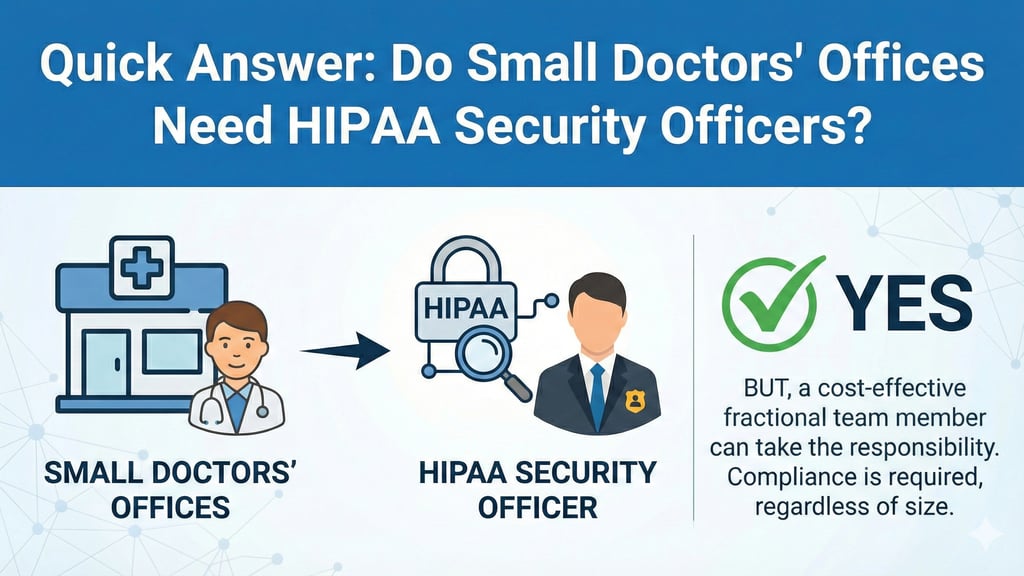
Short answer: Yes—small and medium sized doctors’ offices are required under HIPAA to designate someone responsible for security. However, HIPAA does not require a full-time, formally titled “HIPAA Security Officer.” What it requires is clear accountability.
Under the HIPAA Security Rule, every covered entity, regardless of size, must identify a security official responsible for developing and implementing security policies and procedures. This obligation applies equally to solo practices, small clinics, and large health systems. The regulation is explicit about responsibility, not organizational structure.
What HIPAA Actually Requires
HIPAA is intentionally flexible. It recognizes that a small medical practice does not operate like a hospital system. As a result, the rule allows practices to scale their compliance efforts based on complexity, resources, and risk profile. That flexibility, however, does not eliminate the requirement to assign security oversight.
In practice, this means:
Someone must be accountable for safeguarding electronic protected health information (ePHI)
That person must oversee administrative, technical, and physical safeguards
Security responsibilities must be documented and defensible in the event of an audit or breach investigation
A common misconception is that informal or shared responsibility is sufficient. It is not. When no one is clearly designated, enforcement agencies tend to conclude that no one was accountable—a finding that often worsens outcomes after incidents.
Why Small Practices Are Often at Higher Risk
Small doctors’ offices frequently rely on outsourced IT providers, cloud-based electronic health record systems, and third-party vendors. While these tools can be effective, they do not transfer compliance responsibility. The covered entity remains accountable for:
Risk analysis and risk management
Vendor oversight and business associate management
Workforce security and access controls
Incident response and breach readiness
Without a clearly designated security official, these obligations are often handled reactively, inconsistently, or not at all.
Practical Options for Meeting the Requirement
For many small practices, appointing an internal staff member as a part-time security official may seem practical, but it often introduces risk if that individual lacks the necessary expertise or authority. An increasingly common alternative is engaging a fractional HIPAA Security Officer.
A fractional model provides:
Dedicated security leadership without adding internal operational burden
Objective oversight of risk, vendors, and safeguards
Documented compliance aligned with regulatory expectations
Ongoing guidance as technology and threats evolve
Bottom Line
Small doctors’ offices do need a HIPAA Security Officer in the functional sense—even if not in title or full-time capacity. The key requirement is clear, documented accountability for HIPAA security compliance. For many practices, a fractional security officer offers the most reliable and scalable way to meet that obligation while reducing regulatory and operational risk. Reach out today to learn more!
Contact
Reach out for tailored privacy and security guidance
peter@cardinalprivacy.com
© 2025. All rights reserved.
Website Privacy Notice: This website is operated only on a business-to-business basis and is out of scope for California Privacy Regulations due to the size and nature of the operator.