Quick Answer: Do vendors need to complete security training?
Usually, but not always
1/23/20262 min read
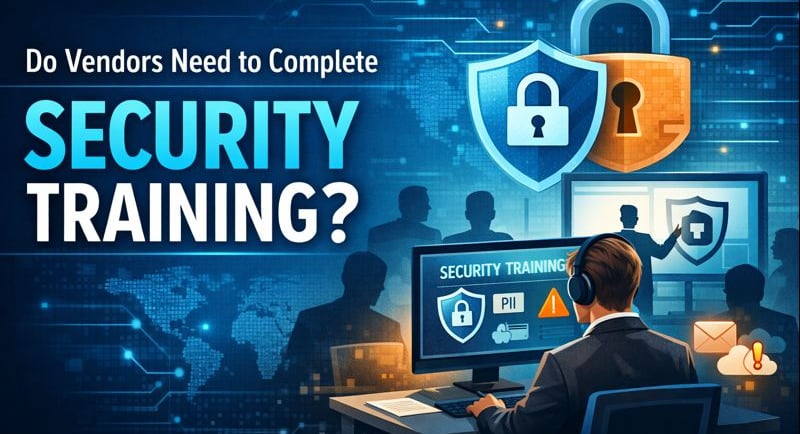
Yes—vendors should be required to complete security training when they process personally identifiable information (PII) or perform functions that are operationally critical to your business. In these scenarios, vendors are not peripheral service providers; they are extensions of your internal environment. Treating them otherwise creates material security, privacy, and continuity risk.
From a governance perspective, security training is not about courtesy or optics. It is about risk alignment. Any vendor that touches sensitive data or supports systems essential to business operations has the ability—intentionally or accidentally—to introduce threats such as data breaches, ransomware exposure, regulatory noncompliance, or operational disruption. Training is one of the most practical controls available to reduce those risks.
Why training matters for high-risk vendors
Most security incidents do not begin with advanced technical exploits. They begin with basic failures: phishing emails, poor password hygiene, insecure data handling, or misunderstandings about incident reporting. When vendors handle PII, these failures can trigger privacy obligations under laws and frameworks that place responsibility squarely on the hiring organization—not the vendor.
Similarly, vendors that are operationally critical, even if they do not process large volumes of PII, can create systemic risk. A vendor administrator clicking a malicious link or mishandling credentials can disrupt core systems, halt operations, or compromise availability. Security training sets baseline expectations and reduces dependency on informal assumptions about “common sense.”
Training should scale with vendor risk
Not all vendors require the same level of security training. A risk-based vendor management program should distinguish between:
Low-risk vendors, such as marketing tools with no access to sensitive data, where contractual security assurances may be sufficient.
Moderate-risk vendors, who access limited internal systems or data, and should receive targeted training on phishing, access control, and reporting obligations.
High-risk vendors, including those processing PII or supporting mission-critical operations, who should complete formal, documented security and privacy training aligned with recognized standards.
This approach aligns with widely accepted cybersecurity and privacy frameworks, which emphasize proportional controls based on impact and likelihood—not blanket requirements applied indiscriminately.
Training is also a governance signal
Requiring security training sends a clear message: security and privacy are not optional, and responsibility is shared. It also strengthens your organization’s position in audits, regulatory inquiries, and incident response by demonstrating that reasonable preventive measures were in place.
For mid-size enterprises, designing and enforcing these requirements across a diverse vendor ecosystem can be challenging. This is where a Fractional Privacy Officer or Fractional Data Governance Officer adds significant value. These roles help define which vendors require training, what training is appropriate, how completion is documented, and how expectations are enforced over time—without building a full internal program from scratch.
In short, if a vendor processes PII or is operationally critical, security training is not a “nice to have.” It is a necessary control, and one that should be deliberately integrated into a risk-based vendor governance program.
Contact
Reach out for tailored privacy and security guidance
peter@cardinalprivacy.com
© 2025. All rights reserved.
Website Privacy Notice: This website is operated only on a business-to-business basis and is out of scope for California Privacy Regulations due to the size and nature of the operator.