Quick Answer: Is ChatGPT an AI Agent
No, not by itself
2/3/20262 min read
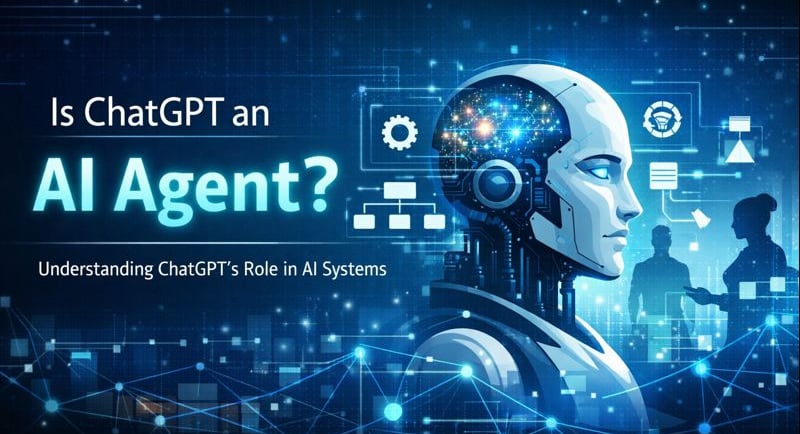
ChatGPT is best understood as a general-purpose AI model, not an autonomous AI agent.
At its core, ChatGPT is a large language model designed to generate text in response to user prompts. It reasons, summarizes, drafts, explains, and analyzes—but it does so reactively. It does not independently decide to take actions, pursue goals, or operate over time without human direction.
That distinction matters, because the term “AI agent” is often used loosely.
What Actually Defines an AI Agent
An AI agent typically has several characteristics that go beyond language generation:
Goal orientation: It can be assigned objectives and work toward them over multiple steps.
Autonomy: It can decide when to act, not just how to respond.
Tool use: It can call external systems—APIs, databases, workflows, or devices.
Persistence: It maintains state or memory across tasks and time.
Environmental interaction: It can observe outcomes and adjust behavior.
ChatGPT, on its own, does none of this. It responds to prompts and stops.
Where the Confusion Comes From
The confusion arises because ChatGPT is often embedded inside agentic systems. When paired with:
Task orchestration layers
Memory stores
Tool-calling frameworks
Permissioned system access
…it becomes the reasoning engine inside an AI agent.
In other words, ChatGPT is the “brain,” not the agent.
The agent is the system around the model that:
Decides when to invoke the model
Supplies context and memory
Executes actions in the real world
Without that scaffolding, ChatGPT remains a powerful but passive tool.
Why This Distinction Matters for Organizations
Treating ChatGPT as if it were an autonomous agent can create real risks:
Governance gaps: Models do not enforce policy—systems do.
Security assumptions: ChatGPT does not act unless prompted; agents can.
Accountability confusion: Responsibility lies with the system design, not the model.
For mid-size enterprises, this distinction is critical when evaluating automation, vendor claims, and AI risk exposure. Many “AI agents” in the market are not new intelligence—they are workflow systems built around base models.
Bottom Line
ChatGPT is not an AI agent.
It is a general-purpose AI model that can be used by agents.
Understanding that difference is essential for responsible deployment, realistic expectations, and effective AI governance. As organizations move from experimentation to operational use, clear architectural and governance frameworks—often supported through fractional AI governance leadership—become the difference between useful automation and unmanaged risk.
Contact
Reach out for tailored privacy and security guidance
peter@cardinalprivacy.com
© 2025. All rights reserved.
Website Privacy Notice: This website is operated only on a business-to-business basis and is out of scope for California Privacy Regulations due to the size and nature of the operator.