Quick Answer: What Are the Main Advantages of Using AI in Business?
Efficiency, Augmentation, and Scale
1/29/20262 min read
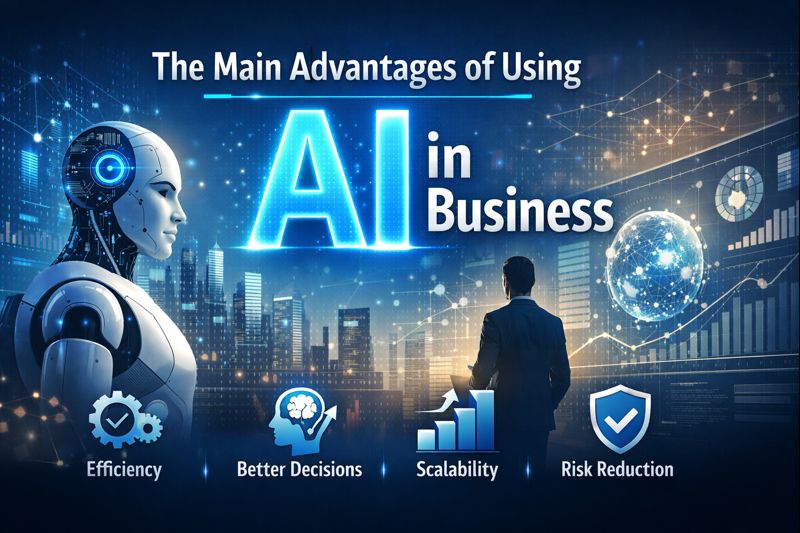
Artificial intelligence is no longer an experimental technology reserved for large enterprises. For many organizations, AI has become a practical tool for improving efficiency, decision-making, and resilience in increasingly complex operating environments. When implemented thoughtfully, the advantages of using AI in business extend well beyond simple automation.
Improved Operational Efficiency
One of the most immediate benefits of AI is its ability to automate repetitive, rules-based tasks. This includes activities such as data classification, document review, workflow routing, and basic customer interactions. By reducing manual effort, AI allows teams to focus on higher-value work that requires judgment, creativity, or strategic thinking. The result is faster execution, fewer errors, and more consistent outcomes across core processes.
Enhanced Decision-Making
AI systems excel at identifying patterns across large and diverse data sets. In a business context, this translates into more informed and timely decisions. Predictive analytics, anomaly detection, and scenario modeling can help leaders anticipate risks, evaluate opportunities, and respond proactively rather than reactively. Importantly, AI augments human decision-making rather than replacing it, providing insights that would be difficult to surface through traditional analysis alone.
Scalability Without Linear Growth
As organizations grow, operational complexity often increases faster than internal capacity. AI enables scalability by handling increased volumes of data, transactions, and interactions without a proportional increase in staffing or infrastructure complexity. This makes it easier to support expansion, new offerings, or regulatory obligations without overextending internal teams.
Consistency and Risk Reduction
AI-driven systems apply rules and policies consistently, reducing variability caused by manual processes. This consistency is particularly valuable in areas such as compliance, data handling, and vendor oversight, where deviations can create significant risk. When properly governed, AI can strengthen controls, improve auditability, and support more defensible operational practices.
Better Customer and Stakeholder Experiences
AI can also improve how organizations interact with customers, partners, and employees. Personalized responses, faster issue resolution, and more accurate information delivery all contribute to higher trust and satisfaction. Over time, these improvements can translate into stronger relationships and competitive differentiation.
Strategic Enablement Through Governance
The advantages of AI are fully realized only when its use is aligned with clear governance, privacy, and security frameworks. Without appropriate oversight, AI can introduce new risks alongside its benefits. This is where structured AI governance, supported by Fractional Privacy Officer, Fractional Data Governance Officer, and AI Governance services, becomes essential. These roles help organizations deploy AI responsibly, ensuring that efficiency gains and strategic insights are achieved without compromising compliance, trust, or long-term sustainability.
In short, AI offers meaningful advantages in efficiency, insight, scalability, and risk management—but only when paired with disciplined governance and expert oversight.
Contact
Reach out for tailored privacy and security guidance
peter@cardinalprivacy.com
© 2025. All rights reserved.
Website Privacy Notice: This website is operated only on a business-to-business basis and is out of scope for California Privacy Regulations due to the size and nature of the operator.