Quick Answer: What Is AI Good At and What Does It Struggle With?
Great at the quantitative; Not so much at the interpersonal
1/28/20262 min read
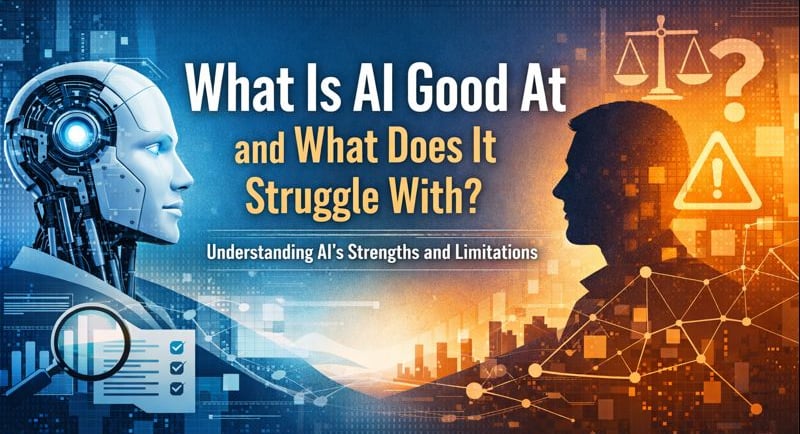
Artificial intelligence is often described in sweeping terms—either as a transformational force or as an overhyped risk. In practice, AI’s value lies in understanding where it excels and where its limitations remain, particularly for organizations trying to deploy it responsibly.
What AI Is Good At
AI systems are exceptionally strong at tasks that involve scale, pattern recognition, and speed. In operational contexts, this includes:
Processing large volumes of data far more quickly than humans can, identifying correlations, trends, and anomalies that would otherwise go unnoticed.
Automating repeatable, rules-based work, such as document classification, data tagging, summarization, or first-pass analysis.
Supporting decision-making by generating options, comparisons, or forecasts based on historical data and defined parameters.
Enhancing consistency, especially in environments where human judgment might vary due to fatigue, workload, or incomplete information.
When properly governed, AI can function as a force multiplier—augmenting human expertise rather than replacing it—by reducing friction and freeing professionals to focus on higher-value judgment and strategy.
What AI Struggles With
Despite its strengths, AI has well-defined limitations that are frequently underestimated:
Contextual and moral judgment. AI does not understand intent, ethics, or values; it predicts likely outputs based on training data. This makes it unreliable as a final decision-maker in sensitive or regulated domains.
Data quality and bias. AI systems inherit the assumptions, gaps, and biases present in their training data, which can create compliance, fairness, and reputational risks.
Novel or ambiguous situations. AI performs best in environments similar to what it has seen before. It struggles when facts are incomplete, objectives conflict, or circumstances are genuinely new.
Accountability. AI cannot be held responsible for outcomes. Organizations remain accountable for errors, misuse, or regulatory violations resulting from AI-enabled processes.
These limitations mean that AI is poorly suited to operate without clear guardrails, defined oversight, and integration into existing governance structures.
Why This Distinction Matters
The real risk with AI is not that it is ineffective, but that it is misapplied. Treating AI as a substitute for human judgment rather than a controlled operational tool often leads to overreach, compliance exposure, and strategic confusion.
This is why many organizations benefit from structured AI Governance supported by experienced leadership. A Fractional Privacy Officer, Fractional Data Governance Officer, or AI Governance lead can help define where AI should be used, where it should not, and how accountability, risk management, and regulatory obligations are maintained. When AI’s strengths are aligned with appropriate controls, it becomes a durable advantage rather than a liability.
Contact
Reach out for tailored privacy and security guidance
peter@cardinalprivacy.com
© 2025. All rights reserved.
Website Privacy Notice: This website is operated only on a business-to-business basis and is out of scope for California Privacy Regulations due to the size and nature of the operator.