Quick Answer: When Should a Privacy Notice Be Given?
Early, early, early
1/14/20262 min read
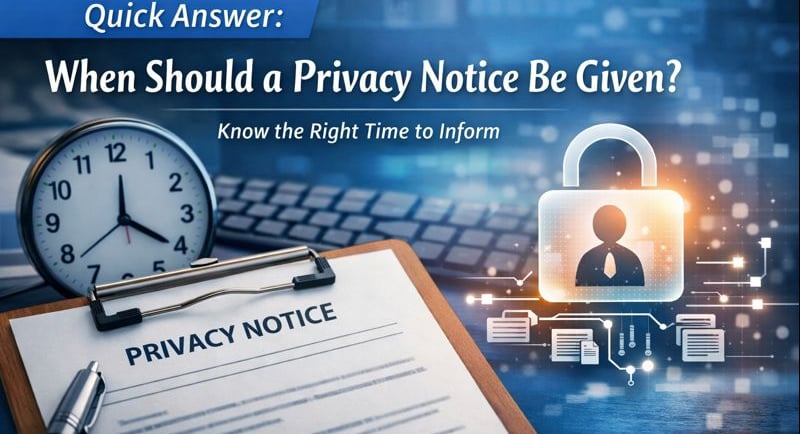
A privacy notice should be given at or before the point where personal data is collected. In practical terms, this means individuals must be informed about how their data will be used before they provide it, or as soon as possible if the data is obtained indirectly. Timing is not a formality—it is a core requirement of modern privacy laws and a foundational element of lawful, transparent data processing.
Most global privacy frameworks, including GDPR, U.S. state privacy laws, and sector-specific regulations, are aligned on this principle. The purpose of a privacy notice is to ensure individuals can make an informed decision about whether to engage, disclose information, or exercise their rights. If notice is provided after data collection, that purpose is undermined.
Common Scenarios Where Notice Is Required
A privacy notice should be presented in the following situations:
Direct collection: When personal data is collected directly from an individual, such as through a website form, account registration, application process, or intake questionnaire, the notice should be visible at the point of collection.
Indirect collection: If personal data is obtained from a third party or public source, notice should be provided within a reasonable time after collection, or at the first point of communication with the individual.
New or changed purposes: If data is later used for a purpose that was not originally disclosed, an updated notice must be provided before the new processing begins.
Material changes to practices: When data-sharing practices, retention periods, or categories of data collected change in a meaningful way, individuals should receive updated notice.
Why Timing Matters
Providing a privacy notice late—or burying it in hard-to-find locations—creates regulatory risk and erodes trust. Regulators increasingly scrutinize not just whether a notice exists, but whether it was timely, clear, and reasonably accessible. From an operational standpoint, late notice often signals deeper governance gaps, such as unclear data flows or inconsistent ownership of privacy compliance.
Operational Best Practice
Well-governed organizations treat privacy notice timing as a design requirement, not a legal afterthought. Notices are embedded into workflows, reviewed when systems change, and aligned with actual data practices rather than aspirational policies.
For many mid-size organizations, maintaining this level of alignment over time is challenging without dedicated oversight. This is where a Fractional Privacy Officer model is particularly effective—providing ongoing governance, notice reviews, and change management support without the burden of a full-time hire. As data use expands across vendors, platforms, and AI-driven tools, disciplined notice timing becomes a key indicator of privacy maturity.
In short, a privacy notice should always be given before personal data is used, not after questions arise.
Reach out today for help drafting and displaying your privacy notice!
Contact
Reach out for tailored privacy and security guidance
peter@cardinalprivacy.com
© 2025. All rights reserved.
Website Privacy Notice: This website is operated only on a business-to-business basis and is out of scope for California Privacy Regulations due to the size and nature of the operator.