Quick Answer: Why Did Clawdbot Blow Up the Internet?
It revealed exciting opportunities of AI agents and the great dangers of leaving them ungoverned
2/4/20262 min read
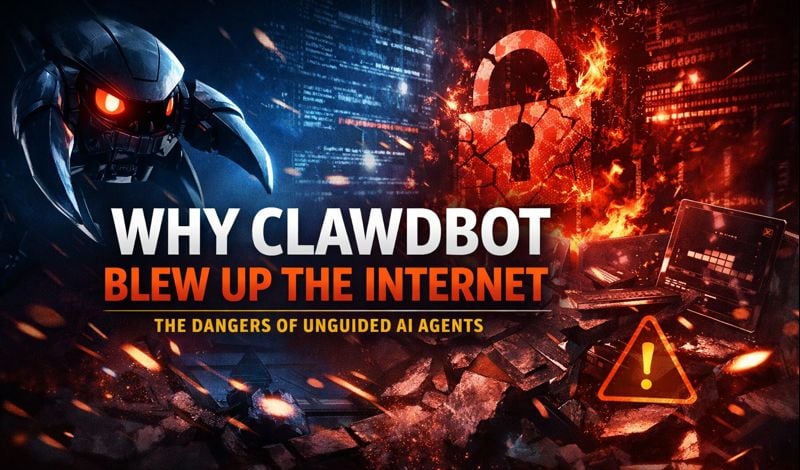
Clawdbot (later renamed Moltbot in a trademark dispute) exploded into public consciousness because it crossed a line most AI tools haven’t yet crossed: it acts. Not just chats. Not just drafts. It can autonomously operate on a local device, receive remote commands, and execute real-world tasks without a human in the loop. That combination—agency plus reach—made people realize, almost overnight, that “AI agents” are no longer theoretical.
That realization is why it went viral.
Most mainstream AI tools still sit safely behind user prompts and approval clicks. Clawdbot-style agents do not. They blur the boundary between software, employee, and outsourced operator. The internet reacted because people instinctively understood the implication: if this works, the bottleneck on white-collar work just disappeared.
But here’s the part that didn’t trend on social media.
Unguided, ungoverned agents like this are a security and operational risk by default.
From a security standpoint, an autonomous agent with local execution capability is functionally equivalent to a highly privileged user who never sleeps, never forgets credentials, and never questions instructions. If it is compromised, misconfigured, or simply misunderstood, it can:
Access sensitive data far beyond its original intent
Perform actions that violate privacy, security, or contractual obligations
Become an attack surface for adversaries who no longer need phishing emails—just prompt injection
From an operations perspective, the risk is just as serious. Agents do not understand organizational context unless you explicitly give it to them. They do not intuit priorities, escalation paths, or regulatory boundaries. An agent optimizing for “task completion” can very efficiently break workflows, overwrite systems of record, or create hidden dependencies that no one realizes exist until something fails.
This is why Clawdbot blew up: it made visible a future that is arriving faster than most organizations are prepared for.
AI agents will transform productivity. They will enable higher-quality services at scale. But deploying them without guardrails is not innovation—it’s negligence. Governance, access control, monitoring, and clear operational boundaries are not optional extras; they are prerequisites.
For organizations experimenting with agentic AI, the lesson is simple:
If you would not give an intern unfettered access to your systems and data, you should not give it to an autonomous agent either.
This is precisely where structured AI governance, privacy oversight, and data control become essential. Fractional AI Governance, Privacy, and Data Governance leadership provide a practical way to harness agentic tools like Clawdbot without turning your operations into an uncontrolled experiment. The technology is powerful. The risk is real. Maturity—not hype—will determine who benefits and who pays the price.
Contact
Reach out for tailored privacy and security guidance
peter@cardinalprivacy.com
© 2025. All rights reserved.
Website Privacy Notice: This website is operated only on a business-to-business basis and is out of scope for California Privacy Regulations due to the size and nature of the operator.