Quick Answer: Will AI Hurt My Employees?
Not if you deploy it correctly
1/30/20262 min read
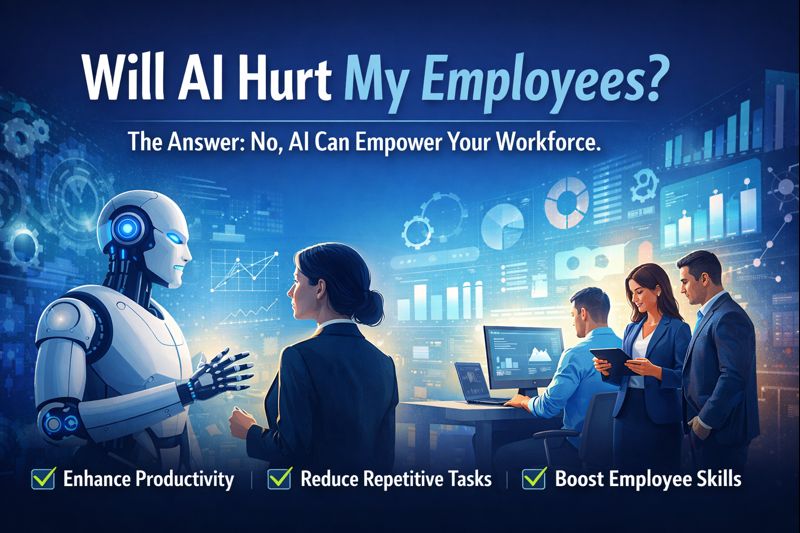
The short answer is no—when implemented responsibly, AI should not hurt your employees. In practice, AI is far more likely to change how people work than to eliminate their value. For most organizations, AI functions as a force multiplier, not a replacement.
AI systems are best suited for tasks that are repetitive, rules-based, or data-intensive. These are the very activities that often frustrate employees and divert attention away from higher-value work. By automating routine analysis, data entry, monitoring, or content generation, AI frees employees to focus on judgment, creativity, relationship management, and decision-making—areas where human expertise remains indispensable.
The real risk to employees does not come from AI itself, but from unmanaged or poorly governed AI adoption. When organizations deploy AI without clear policies, role definitions, or accountability structures, employees may feel uncertainty about expectations, performance evaluation, or job security. This is a governance problem, not a technology problem.
When AI is introduced with intention, several positive outcomes tend to emerge:
Role enrichment rather than role elimination. Employees gain access to tools that increase their effectiveness and professional leverage.
Skill acceleration. AI can enable earlier-career staff to perform at a higher level by providing decision support, drafting assistance, or analytical insights.
Reduced burnout. Offloading low-value tasks improves job satisfaction and reduces cognitive overload.
More consistent outcomes. AI-supported workflows often reduce errors and variability, making employees more confident in their work product.
Importantly, AI does not absolve organizations of responsibility. Humans remain accountable for outcomes, compliance, and ethical decision-making. Employees are still required to exercise oversight, validate outputs, and apply contextual judgment. This reinforces, rather than diminishes, the importance of human roles.
To ensure AI helps rather than harms employees, organizations should focus on three fundamentals:
Clear governance: Define acceptable use, accountability, and escalation paths for AI-supported work.
Transparency: Be explicit with employees about where AI is used and how it affects workflows and evaluation.
Enablement: Train employees to use AI as a tool, not fear it as a threat.
For mid-size enterprises in particular, structured AI governance can turn employee concern into employee advantage. A well-designed AI program—supported by fractional AI governance and data governance expertise—ensures that AI adoption strengthens your workforce, improves operational resilience, and aligns technology use with organizational values.
Used correctly, AI does not hurt employees. It equips them to do their best work.
Contact
Reach out for tailored privacy and security guidance
peter@cardinalprivacy.com
© 2025. All rights reserved.
Website Privacy Notice: This website is operated only on a business-to-business basis and is out of scope for California Privacy Regulations due to the size and nature of the operator.