The Compliance Illusion
Why SOC 2 and ISO 27001 Are Just the Starting Line
12/15/20256 min read
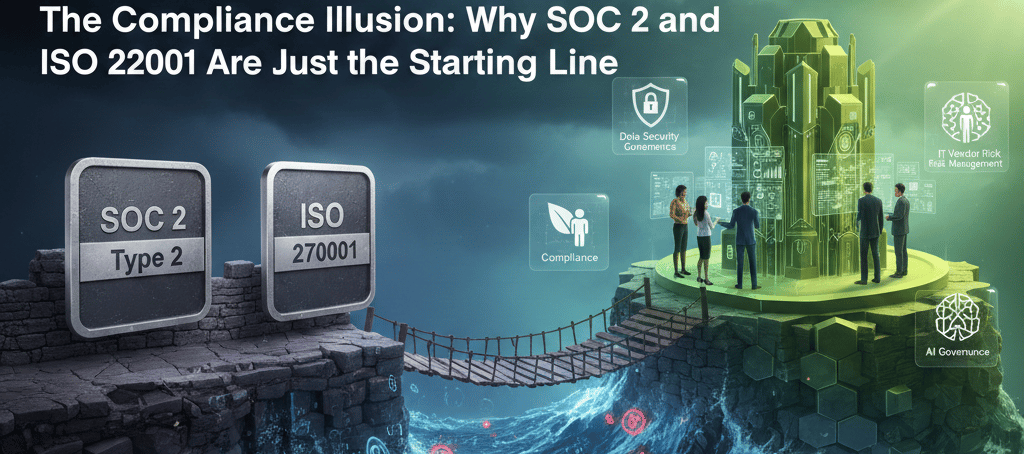
In the high-stakes world of B2B SaaS, HealthTech, and FinTech, trust is the ultimate currency. To mint this currency, companies spend months and tens of thousands of dollars chasing two specific badges: SOC 2 Type 2 and ISO 27001.
For many mid-market enterprises, achieving these certifications feels like the summit. You have the report, you have the certificate, and you have the logos in your website footer. You assume you are "safe."
But here is the uncomfortable reality: A badge is not a strategy.
While SOC 2 and ISO 27001 are foundational frameworks for demonstrating information security hygiene, they are fundamentally insufficient for businesses operating in regulated industries or scaling through the mid-market. They are snapshots in time—static answers to dynamic problems.
If your risk strategy relies solely on these audits, you are leaving massive operational gaps in Data Security Governance, Privacy Compliance, Vendor Risk, and the rapidly emerging field of AI Governance.
This article compares these two compliance heavyweights, exposes their specific limitations, and explains why a holistic governance approach—led by a fractional strategic partner—is the only way to truly de-risk your organization.
Part 1: The Baseline — Understanding SOC 2 and ISO 27001
Before dissecting what they lack, we must respect what they provide. These frameworks are the "table stakes" for entering the enterprise supply chain.
What is SOC 2 Type 2?
Service Organization Control 2 (SOC 2) is an auditing standard maintained by the AICPA. It is designed to prove to your customers that you have controls in place to protect their data.
The Scope: It focuses on the "Trust Services Criteria": Security (mandatory), Availability, Processing Integrity, Confidentiality, and Privacy.
The Mechanism: It is an attestation. An external auditor verifies that your controls were designed (Type 1) and operated effectively over a specific period (Type 2).
The Limitation: It is highly customizable. You define your own controls. If you set the bar low and hurdle it, you can still get a "clean" report.
What is ISO 27001?
ISO/IEC 27001 is the international standard for an Information Security Management System (ISMS).
The Scope: It focuses on the management of risk. It requires a cycle of continuous improvement (Plan-Do-Check-Act).
The Mechanism: It is a pass/fail certification.
The Limitation: It verifies you have a system for managing security. It does not necessarily verify that your security strategy aligns with your specific business goals or the newest regulatory changes.
The "Security Theater" Trap
There is a roughly 80% overlap between the two. Both require access controls, encryption, and incident response plans. However, possessing these badges often creates "Security Theater."
You may have a policy that says "we review logs," satisfying the auditor. But without Strategic Governance, you may not know what you are looking for in those logs, or how that data connects to your AI model's training set.
Part 2: The Four Pillars of True Governance (That Audits Miss)
To survive in a regulated environment, you must move beyond the "audit mindset" to a "governance mindset." This requires active management in four key areas where SOC 2 and ISO 27001 fall short.
1. Data Security Governance (Strategy vs. Execution)
There is a vital distinction between Information Security (the execution) and Data Security Governance (the strategy).
Your Managed Security Service Provider (MSSP) or IT team handles execution: they configure firewalls, install endpoint protection, and patch servers. SOC 2 validates that these tasks happened.
Data Security Governance is different. It asks the questions the auditor won't:
Why are we collecting this data?
Does our security posture align with our risk appetite?
Are business stakeholders accountable for the data they own?
ISO 27001 provides a skeleton for this, but it doesn't provide the brain. A Fractional Officer provides the strategic oversight to ensure your security investments are actually reducing business risk, not just checking boxes. We don't configure the tool; we define the policy that dictates how the tool must be used to meet business objectives.
2. The Privacy Gap (Rights vs. Locks)
The most dangerous misconception is that "Secure" equals "Private."
Security is about preventing unauthorized access (keeping the bad guys out). Privacy is about authorized use (how you treat the good guys' data).
You can have a SOC 2 Type 2 report with zero exceptions and still violate the GDPR, CCPA, or HIPAA.
Audits: Check if you have a privacy policy.
Governance: Checks if you honor that policy.
SOC 2 won't help you build a Data Subject Access Request (DSAR) workflow. It won't help you determine if you are legally allowed to share data with a marketing partner. It won't map your Record of Processing Activities (ROPA). Only a dedicated Privacy Officer function can bridge the gap between technical security controls and legal privacy obligations.
3. IT Vendor Risk Management (The Supply Chain Blindspot)
Modern companies are not monoliths; they are a mesh of APIs and third-party SaaS tools.
SOC 2 and ISO 27001 require you to "manage supplier relationships." In practice, most companies satisfy this by asking their vendors for their SOC 2 reports once a year and filing them away in a folder.
This is not risk management; it is compliance administration.
True IT Vendor Risk Management requires a proactive, tiered approach:
Inherent Risk Assessment: Before you sign the contract, what is the risk of giving this vendor our data?
Data Sovereignty: If we use this vendor, does our data leave the EU/US?
Contractual Safeguards: Does the DPA (Data Processing Addendum) shift liability to them if they breach?
A Fractional Officer moves you from "collecting certificates" to "assessing risk," ensuring you aren't blindsided when a critical vendor like SolarWinds or MoveIt is compromised.
4. AI Governance (The Uncharted Territory)
This is the area where legacy frameworks like SOC 2 and ISO 27001 are currently most obsolete. They were written before the generative AI boom.
If your employees are pasting code into ChatGPT, or if your product wraps an LLM (Large Language Model), you face risks that standard audits do not cover:
Hallucinations & Integrity: Is the AI output reliable?
IP Leakage: Are you training a public model with your proprietary data?
Bias & Ethics: Is your algorithm discriminating against protected classes?
AI Governance is the new frontier. It requires specific Acceptable Use Policies (AUPs), transparency frameworks (EU AI Act), and risk assessments for algorithmic decision-making. You cannot audit your way out of AI risk; you must govern it.
Part 3: The Role of the Fractional Officer
The dilemma for the mid-market (50–500 employees) is resource allocation.
You are too big to ignore these risks—regulators and enterprise clients are watching you. Yet, you may not have the budget or the headcount for a full-time Chief Privacy Officer (CPO), a Chief Information Security Officer (CISO), and a Head of Risk.
This is where the Fractional Officer model delivers high-impact value.
Not a "Doer," But an "Architect"
A Fractional Officer does not replace your IT team or your legal counsel. Instead, we act as the connective tissue between them.
We don't manage the firewall; we draft the Governance framework that tells IT what to protect and why.
We don't litigate; we interpret privacy laws (GDPR/CPRA) into operational workflows that Engineering can build.
We don't just buy software; we assess the vendors to ensure they don't introduce supply chain poison.
From Cost Center to Revenue Enablement
The most significant shift a Fractional Officer provides is turning compliance from a blockage into a bridge.
When your sales team is stuck in a procurement cycle with a massive enterprise bank or health system, sending a SOC 2 report is often not enough. They will ask about your AI ethics. They will ask about your sub-processor management. They will ask about your data retention strategy.
Having a strategic partner who can answer those questions competently—and back them up with a mature governance program—shortens sales cycles and builds deep institutional trust.
Conclusion: The Difference Between Passing and Leading
SOC 2 Type 2 and ISO 27001 are essential credentials. They are the admission ticket to the game. But playing the game—and winning it—requires more than just the ticket.
For regulated industries and growing mid-market firms, the risks are too complex to be solved by a checklist.
Security Governance ensures your defenses align with business strategy.
Privacy Oversight ensures you respect user rights and the law.
Vendor Management secures your supply chain.
AI Governance future-proofs your innovation.
Do not mistake the map (the audit) for the territory (the risk). By engaging a Fractional Officer to oversee these critical pillars, you move beyond simple compliance and build a resilient, trustworthy, and scalable enterprise.
Take the Next Step
Is your organization relying on a "check-the-box" strategy or no strategy at all? Contact us to get started today!
Contact
Reach out for tailored privacy and security guidance
peter@cardinalprivacy.com
© 2025. All rights reserved.
Website Privacy Notice: This website is operated only on a business-to-business basis and is out of scope for California Privacy Regulations due to the size and nature of the operator.