The Efficiency Multiplier
Driving Mid-Market ROI Through Fractional IT and AI Leadership
12/18/20255 min read
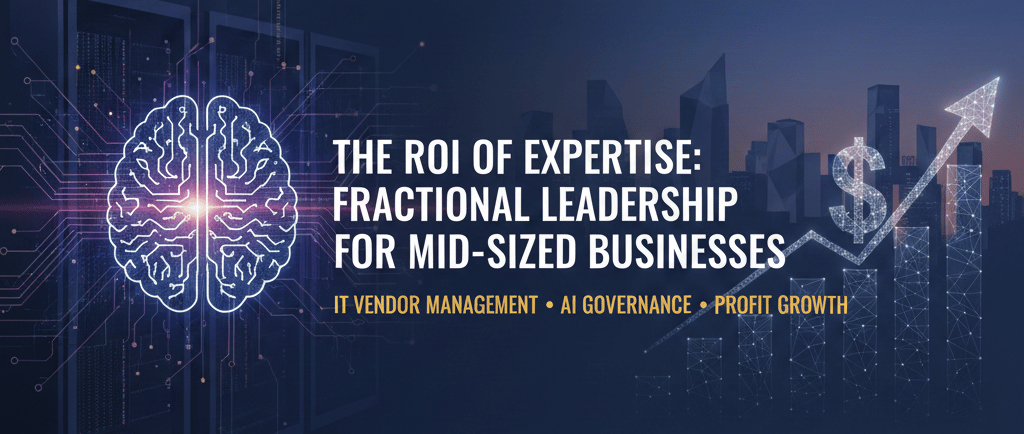
For mid-sized enterprises, the path to growth is often paved with complexity. As revenue scales, so does the digital infrastructure required to support it. Suddenly, the ad-hoc software purchases that worked in the startup phase become a tangled web of unmanaged vendors. Simultaneously, the rapid emergence of Artificial Intelligence presents a dual-edged sword: a massive opportunity for efficiency, paired with significant operational and reputational risk.
Navigating this landscape requires executive-level experience. Yet, for many organizations in the mid-market sector, the cost of retaining a full-time Chief Information Officer (CIO), Chief Information Security Officer (CISO), or a dedicated Vendor Management team is difficult to justify against the bottom line.
This creates a "governance gap" where IT spend bleeds, risks accumulate, and strategic opportunities are missed.
The solution gaining traction among forward-thinking boards is the Fractional Officer model. By bringing in high-level expertise on a flexible basis to manage IT vendors and govern AI adoption, mid-sized businesses are discovering a pathway to enterprise-grade maturity. This approach is not merely a cost-saving measure; it is a strategic investment that yields tangible, demonstrable returns on investment through operational rigor, risk reduction, and commercial enablement.
The Financial Architecture of IT Vendor Management
In many mid-sized organizations, IT vendor management is treated as an administrative task—something handled by procurement or individual department heads. This decentralized approach almost inevitably leads to value leakage. A Fractional Officer transforms vendor management from a clerical necessity into a strategic asset that protects EBITDA.
Stopping the Leakage of "Shadow IT"
One of the most silent erosions of profit occurs through "Shadow IT"—software and services purchased by teams without central oversight. While the intent is often innovation or speed, the result is a fragmented ecosystem where the company pays for redundant capabilities.
A Fractional Officer conducts a comprehensive rationalization of the technology stack. By identifying overlapping tools—such as three different project management platforms across three departments—and consolidating them into enterprise-wide agreements, the business achieves immediate operational efficiency. The ROI here is twofold: the direct reduction of licensing costs and the elimination of the administrative burden of managing multiple disparate relationships.
Leveraging Market Intelligence for Contract Renewals
Vendor contracts often contain auto-renewal clauses with built-in price escalations. Without a dedicated eye on the calendar and the terms, businesses often find themselves locked into unfavorable rates simply due to inertia.
An expert Fractional Officer brings deep market intelligence to the negotiation table. Unlike an internal manager who may negotiate a CRM contract once every three years, a Fractional Officer negotiates these contracts constantly across multiple clients. They know the current market rates, the "give-gets" that vendors are willing to concede, and the leverage points that drive down costs. This ensures that every dollar spent on IT is optimized for value, turning procurement into a source of capital efficiency rather than a cost center.
Mitigating Third-Party Risk
Operational stability is a key component of financial health. In an interconnected digital economy, a business is only as secure as its least secure vendor. A breach originating from a third-party provider can disrupt operations, halt revenue generation, and incur massive remediation costs.
A Fractional Officer implements rigorous Third-Party Risk Management (TPRM) protocols. By ensuring vendors adhere to strict security and privacy standards before contracts are signed, the business insulates itself from supply chain shocks. This preventive approach preserves the company’s valuation and prevents the operational paralysis that often follows a third-party security incident.
AI Governance: Capital Efficiency in the Age of Intelligence
The pressure to adopt Artificial Intelligence is intense. However, for the mid-market, the danger lies in "adoption for adoption's sake." Without a clear strategy, capital is easily wasted on pilot programs that never scale or generic tools that fail to deliver competitive differentiation.
Moving Beyond "Pilot Purgatory"
Many businesses fall into the trap of launching numerous small-scale AI experiments that consume resources but fail to integrate into core business processes. A Fractional Officer specializing in AI governance acts as a strategic filter.
By focusing on high-impact use cases—such as automating repetitive operational tasks or enhancing customer support throughput—the Fractional Officer ensures that capital is directed only toward initiatives with a clear path to value. This disciplined approach prevents waste and accelerates the time-to-value for AI investments, ensuring that technology serves the business strategy, not the other way around.
Protecting Intellectual Property and Brand Equity
The hidden cost of unmanaged AI is the potential loss of Intellectual Property (IP). When employees use public, open-model AI tools to generate code, summarize meetings, or analyze proprietary data, they may inadvertently expose the company's "secret sauce" to the public domain.
A Fractional Officer establishes the governance frameworks necessary to use AI safely. This involves deploying enterprise-grade environments where data remains private and establishing Acceptable Use Policies (AUPs). By securing the company’s data assets, the business avoids the catastrophic financial implications of IP theft or regulatory non-compliance. The ROI here is measured in the preservation of the company’s long-term competitive advantage.
Privacy and Security as Commercial Enablement
In the modern B2B landscape, a robust security and privacy posture is no longer just a compliance requirement; it is a sales accelerator. Mid-sized businesses are increasingly selling to larger enterprises that demand rigorous proof of security (such as SOC 2 or ISO 27001) before signing contracts.
Shortening the Sales Cycle
When a lucrative deal is on the table, the "Security Questionnaire" phase can be a major bottleneck. If an internal team lacks the documentation or the governance structure to answer these inquiries confidently and quickly, deals stall. In worst-case scenarios, they are lost to competitors who are more prepared.
A Fractional Officer builds a "Trust Center"—a proactive suite of security and privacy documentation. This readiness allows the sales team to bypass lengthy security reviews and move directly to closing. By removing friction from the sales process, the business realizes revenue faster and improves its win rate against larger, more established competitors.
Lowering the Total Cost of Risk
Cyber insurance premiums have risen sharply, and insurers are becoming increasingly selective. They now demand evidence of mature governance, such as Multi-Factor Authentication (MFA), incident response planning, and regular training.
By bringing in a Fractional Officer to professionalize the security stack, a business presents a lower risk profile to insurers. This often facilitates access to better coverage terms and more favorable premiums. Furthermore, a robust governance posture reduces the likelihood of regulatory fines under laws like GDPR or CCPA, protecting the balance sheet from unforeseen liabilities.
The Economic Logic of the Fractional Model
Ultimately, the decision to engage a Fractional Officer is an exercise in resource allocation. For a mid-sized business, the goal is to access Fortune 500-level capability without incurring Fortune 500-level fixed costs.
Converting Fixed Costs to Variable Costs
Hiring full-time C-suite executives requires a massive financial commitment, including heavy base salaries, bonuses, equity, and benefits. For many mid-sized firms, a full-time role may not even be necessary; once the strategy is set and the fires are put out, the day-to-day maintenance does not require a $250k+ resource.
The Fractional model allows the business to convert this heavy fixed cost into a flexible, variable cost. The business pays for high-impact guidance, strategy, and oversight, but delegates execution to lower-cost internal teams. This creates a far more efficient capital structure, freeing up cash flow that can be reinvested into product development, sales, or marketing.
Scalability and Agility
Business needs change rapidly. A Fractional Officer offers the ability to scale engagement up or down based on current initiatives. During a major digital transformation or a merger, the engagement can expand; during "steady state" operations, it can contract to a maintenance retainer. This agility ensures that the business is never over-paying for capacity it doesn't need, nor under-resourced when critical decisions must be made.
Conclusion: Operational Maturity as a Growth Driver
The mid-market businesses that will thrive in the coming decade are those that treat IT and AI not as support functions, but as core drivers of value. However, achieving the necessary level of sophistication does not require bloating the payroll.
By engaging a Fractional Officer to manage IT vendors and govern AI, businesses gain a dual advantage: they stop the hemorrhage of wasteful spend and risk, and they build a foundation for scalable, secure growth.
The return on investment is found in the vendor contracts that are right-sized, the AI tools that actually drive productivity, the sales deals that close faster due to trusted security, and the strategic clarity that comes from having an expert in the room. It is a shift from reactive spending to proactive value creation—a transition that directly impacts the bottom line.
Contact
Reach out for tailored privacy and security guidance
peter@cardinalprivacy.com
© 2025. All rights reserved.
Website Privacy Notice: This website is operated only on a business-to-business basis and is out of scope for California Privacy Regulations due to the size and nature of the operator.